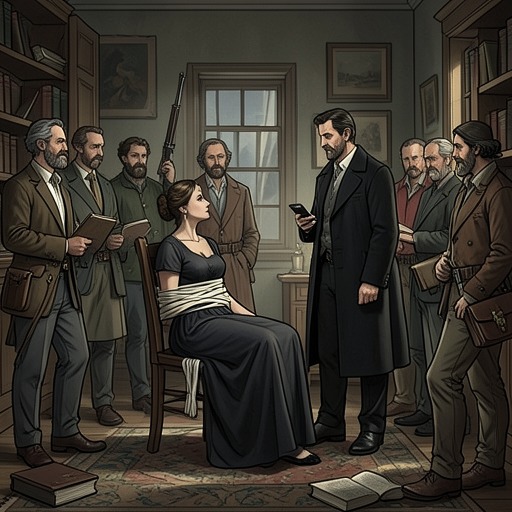
Romy's prison bucket
Of Fates & Fables (The Complete Series)Romy's prison bucket is the faded red camping-style bucket imposed on Romy during her captivity by Brody Harrison and his werebros. First presented as a substitute for privacy, dignity, and ordinary bodily care, it becomes the only usable weapon in Romy's cell and the means by which she attacks Justice. The object therefore marks a decisive reversal: what was supplied to humiliate and control her is repurposed by Romy as an instrument of resistance.
Appearance and Captive Function
The bucket appears after Romy has been held in a dark, windowless room where hunger, dehydration, dizziness, and confinement have reduced her physical options. Once she is finally fed, her body begins to function again, but Derek refuses her request to use a restroom and laughs at her distress. The replacement is a faded red bucket with a toilet seat on top, technically resembling camping equipment but functioning in practice as a device of forced exposure. Romy recognizes that using it in front of Derek, Justice, and the other frat brothers would strip away one of the few remaining boundaries around her body.
The object is thus not merely a container. It belongs to the larger system through which Brody Harrison's group regulates Romy's movement, privacy, communication, and body. Justice offers assistance only if Romy plays along, and she is forced to kiss his cheek while the men laugh. The promised cooperation does not give her access to the outside of the cell or even a chance to inspect the place where she is being held. Instead, it produces the bucket and leaves her surrounded by watchers. Its practical use is inseparable from humiliation: the object makes captivity visible at the most intimate level.
From Humiliation to Opportunity
The bucket's meaning changes when Brody Harrison returns to threaten Romy's transformation and kicks her after she collapses against the wall. Once the door closes, Romy's fight-or-flight response takes over. She searches the cell for something that can serve as a weapon and finds that the mattress and sleeping bag are useless. The toilet, degrading as it is, is the only available possibility. In a bitterly fitting reversal, the tool associated with the way she has been treated becomes the object she can use against the people treating her that way.
Romy removes the seat and ties off the trash bag lining it, separating the bucket from its original sanitary function. She then swings the now-empty container to test its weight and realizes that it is too light for a gradual or restrained attack. Her plan must rely on surprise and shock. This preparation restores a limited form of agency: she cannot control the cell, the guards, Brody Harrison's threats, or the approaching transformation, but she can study the available material world and make a decision about how to use it.
The Attack on Justice
Romy presses her back against the wall beside the door and waits with the bucket held tightly in both hands. While she waits, the object gathers several fears around itself. She considers whether Justice will return alone, whether she is willing to hit him with a urine bucket, whether Brody Harrison, Derek, and Zac will accompany him, and whether she will ever see Talia DuPont, Anna Price, or Kash Montgomery again. The bucket is therefore both a concrete weapon and the focus of an impossible calculation: escape requires violence, but hesitation may leave her without any chance to survive.
When Justice finally enters, carrying something in his hands, Romy strikes before he can finish saying her name. The first blow hits his head, and the object he is carrying falls with a clank as he curses and cups his bleeding nose. Romy does not wait for him to recover. She jumps from her hiding place and swings again, driving the bucket's edge into his temple with enough force to crack it. Justice crumples to the floor, while a furious scream from the hallway signals the retaliation of Brody Harrison's pack.
The cracked bucket completes its reversal from object of submission to evidence of resistance. It does not guarantee Romy's escape, and it cannot match the supernatural power held over her by Brody Harrison and his werebros. Nevertheless, it changes the immediate balance of the scene. Romy acts with the only resource available, accepts the risk of hurting someone who has participated in her captivity, and refuses to remain a passive body awaiting the next command.
Materiality and Power
The bucket also exposes how captivity turns an ordinary object into an instrument of discipline. In Romy's cell, the absence of a restroom is not an incidental inconvenience but part of a structure that makes bodily privacy conditional on the captors' permission. The faded red plastic, the attached toilet seat, and the disposable lining reduce an intimate human need to something monitored and degrading. Derek's refusal and mockery make the object carry the contempt of the people who provide it, while Justice's offer of help links access to basic care with coerced affection and public humiliation. The bucket's material banality sharpens the violence: the captors do not need an elaborate device to assert control when the room itself has been arranged to deny Romy ordinary choices.
That arrangement belongs to a wider pattern of surveillance and coercion. Brody Harrison orders Derek to retrieve Romy's phone and permits only one social-media post, which must be typed under supervision and posted by Derek before the phone is taken away. He also threatens to have Justice or another werewolf punish her if she betrays the arrangement. The bucket and the phone operate on opposite sides of the same system: one controls the most private bodily function, while the other controls Romy's public appearance. Both are made instruments of captivity, and both reveal how her captors attempt to manage not only where she is, but what the outside world can believe about her condition.
Agency Under Constraint
The bucket does not restore Romy's freedom; it gives her a narrow opening within a heavily controlled environment. She remains injured, threatened with werewolf transformation, and uncertain whether she will see Talia DuPont, Anna Price, or Kash Montgomery again. Even so, the decision to use the bucket requires her to reinterpret the conditions imposed on her. The object is no longer only something done to her. It becomes something she can move, conceal, weigh, and direct. Her preparation turns forced passivity into tactical attention, showing agency not as total control but as the ability to act meaningfully with almost no resources.
The choice is morally and emotionally difficult because Justice is the person who enters the cell, not an abstract symbol of the pack. Romy knows that he has not inflicted every injury Brody Harrison has caused, yet his presence is bound to the hierarchy imprisoning her. Her hesitation therefore includes the possibility of harming someone who has shown moments of ambiguity while still serving Brody Harrison's authority. The bucket makes that conflict physical. It is a humiliating object, but it is also the tool that allows Romy to refuse the terms under which Justice approaches her.
Consequences and Significance
The attack changes the bucket's status a second time. At first it is a substitute for a toilet; then it becomes a concealed weapon; after the blows, it is cracked and discarded. Its damage records the cost of resistance more clearly than a triumphant weapon would. Romy has not escaped simply because she has struck Justice. The scream from the hallway announces that the pack can answer with greater force, and the scene ends with danger still surrounding her. Yet the cracked container preserves the fact that the captors' system is not seamless: even an object selected for degradation can become a breach in their control.
Romy's prison bucket therefore functions as a compact emblem of the captivity arc. It gathers hunger, bodily vulnerability, forced exposure, surveillance, threat, and improvised courage into one recurring object. Its significance lies in the contrast between intended use and chosen use. Brody Harrison's werebros offer it as proof that Romy's rights no longer matter; Romy turns it into proof that their power does not determine every action she can take. The bucket's transformation from sanitary substitute to weapon does not erase the humiliation attached to it, but it prevents that humiliation from having the final meaning.